



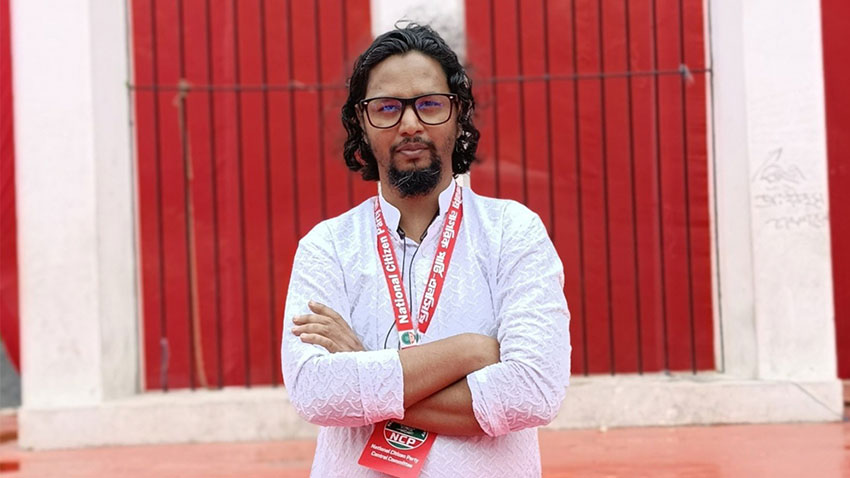
Khan Muhammad Mursaleen, central joint chief coordinator of the National Citizen Party (NCP), has resigned from the party.
Mursaleen announced his resignation in a Facebook post on Thursday (January 1), saying he has stepped down from all posts and responsibilities of the party.
In the post, he wrote that he had been serving as the NCP’s central joint chief coordinator and had also worked in the party’s media cell as well as its publicity and publication wing. He added that he had recently served for a short period as secretary of the party’s election-time media subcommittee.
“From today, I have decided to resign from all positions and responsibilities of the NCP,” he wrote, adding that he has explained the reasons behind his decision in a video message.
Although resigning from the NCP, Mursaleen said he is not withdrawing from politics. “I am leaving the NCP, but not politics. We will meet again on the streets,” he wrote.
In his video message, Mursaleen said he was stepping away from all duties and responsibilities of the National Citizen Party and felt it was necessary to explain why.
He said the core objectives behind the formation of the NCP were the establishment of a new constitution, a new republic or political order, and a discrimination-free Bangladesh—goals that, he said, essentially meant “decolonising” the country.
Mursaleen argued that Bangladesh has remained trapped in a colonial system of governance since the British era, beginning in 1858 when Queen Victoria declared the region a colony. He claimed that the colonial legal and administrative framework, rooted in what he described as a Judeo-Christian ideological foundation, legitimised oppression in the name of a so-called greater national interest.
He said successive rulers in post-1971 Bangladesh followed similar patterns, citing what he described as authoritarian practices during Sheikh Hasina’s 16-year rule, when enforced disappearances and killings were justified in the name of national interest.
Referring to the post-July mass uprising, Mursaleen said the NCP’s call for a “new political settlement” was meant to be part of a long historical struggle to break free from colonial structures.
He cited his family history of resistance, noting that his grandfather, Ekushey Padak-winning poet Khan Mohammad Moinuddin, was involved in the anti-British movement alongside national poet Kazi Nazrul Islam and was imprisoned with him. He also mentioned his father’s lifelong writings against colonial governance and his own decade-long career in journalism aimed at raising political consciousness.
Expressing frustration, Mursaleen said the main force behind the mass uprising—particularly workers who sacrificed the most—failed to be brought into the centre of political power or organised as a political constituency.
He also criticised the marginalisation of women who, he said, played a courageous role during the uprising but were later pushed into the background. “Half of Bangladesh’s population is women. These brave women should have become the voice of the nation, but that did not happen,” he said, alleging that the NCP failed to take a bold stand on the issue.
Mursaleen further accused the NCP of compromising on both the July declaration and the charter, claiming the party failed to maintain a strong position and was forced into concessions due to its inability to transform people into a political force.
“As a result of this weakness, the NCP is now compelled to collaborate and compromise with stakeholders of the old political order,” he said.
Concluding his statement, Mursaleen said his decade-and-a-half-long struggle against colonial governance must continue from within the ranks of the people.
“I am resigning from the NCP, but I am not retiring from politics. I am returning to the people’s ranks, and we will meet again on the streets very soon,” he said.
In recent weeks, at least nine leaders have reportedly resigned from the National Citizen Party.