







Convener of Jatiya Nagorik Party (NCP) Nahid Islam, has alleged that the beneficiaries of Bangladesh’s old, corrupt and discriminatory system have returned to the political arena with full force, seeking to reinstate what he described as an unjust and exploitative state structure.
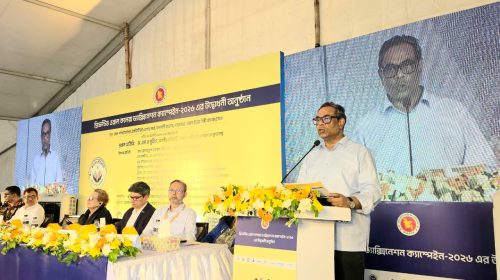
In a nationwide election address on Sunday night, Nahid said the July uprising was a mass rebellion against systemic inequality, aimed at dismantling the old order and establishing a justice-based state.
However, he claimed that those who had long benefited from corruption and authoritarian governance are now mobilizing politically to regain control.
He accused the previous Awami League government, under former prime minister Sheikh Hasina, of running a 15-year “fascist regime” marked by enforced disappearances, extrajudicial killings, torture, mass arrests, and fabricated cases, using state institutions including the police, RAB, BGB, intelligence agencies, civil administration, judiciary, and even sections of the armed forces.
Nahid said that although the July mass uprising dismantled much of this system, remnants of the old power structure remain embedded within state institutions, obstructing justice and reform.
He alleged that thousands of criminals had escaped punishment, with some finding shelter in military facilities or fleeing abroad, undermining public trust in the armed forces and law enforcement agencies.
He criticized the failure of security operations, including “Operation Devil Hunt,” to recover illegal arms, identify offenders, or make meaningful arrests, and accused elements within the security apparatus of sabotaging investigations, including those into enforced disappearances.
Nahid pledged that if NCP is voted into power, his government would take decisive legal action to recover what he described as USD 234 billion siphoned off abroad during the previous regime.
Citing a white paper led by economist Dr Debapriya Bhattacharya, he said the funds were looted by Hasina and her allied business and bureaucratic elites, dealing a devastating blow to the national economy.
He vowed to confiscate the assets of those involved in corruption and money laundering, impose penalties and taxes on identified offshore wealth, and establish a public trust to manage recovered assets under transparent and professional governance.
On foreign policy, Nahid accused the former government of pursuing a subservient and India-centric diplomatic strategy, undermining Bangladesh’s sovereignty and national interests.
He alleged that policy decisions during the past 15 years were heavily influenced by New Delhi, turning Bangladesh into what he termed a “puppet state.”
He also criticized the government’s silence over the killing of Bangladeshi civilians by India’s Border Security Force (BSF), calling it unprecedented in peacetime and a gross violation of human rights.
Outlining NCP’s foreign policy vision, Nahid said his party would pursue a balanced, independent, and dignity-based diplomacy, revive SAARC, seek membership in ASEAN, strengthen ties with Muslim-majority countries, and expand diplomatic missions to better serve expatriate Bangladeshis.
On defense, he accused the previous government of politicizing the armed forces and using them against civilians rather than protecting national sovereignty.
He said NCP would restructure the defense system, prioritize technological modernization, reduce administrative overhead, and introduce mandatory military training for all able citizens over 18 to build a nationwide people’s defense framework.
Addressing economic challenges, Nahid blamed entrenched syndicates of businessmen, politicians, and bureaucrats for persistently high commodity prices, pledging to dismantle such cartels, stabilize markets, and ensure fair pricing of essential goods.
He also vowed sweeping reforms of the police force, accusing it of acting as a partisan tool during the previous regime, and promised prosecution of officers involved in killings, torture, corruption, and abuse of power.
On judicial reform, Nahid said access to justice in Bangladesh had become an exhausting and costly ordeal, marked by police reluctance to file cases, prolonged investigations, repeated court delays, and systemic corruption. He pledged to overhaul the justice system to ensure swift, fair, and accessible legal remedies for all citizens.
Nahid concluded by urging voters to support NCP’s vision of dismantling systemic oppression, ending corruption, restoring justice, and rebuilding Bangladesh on principles of equality, accountability, and national dignity.