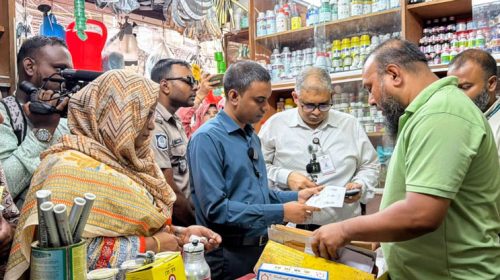












Businesses that repeat the same violations after being fined may face legal action, including the sealing of their establishments, Director General of the National Directorate of Consumer Rights Protection (DNCRP) and Additional Secretary Md Zahirul Islam said on Monday, stressing the need for stronger internal monitoring and coordinated efforts to ensure consumer rights and food safety.
“Regular discussions and exchanges with business leaders will be held to make the Directorate’s activities more effective in keeping commodity prices stable and protecting consumer interests,” he said.
The DNCRP chief made the remarks as the chief guest at a consultation meeting organised to raise awareness about the Consumer Rights Protection Act, 2009, and ensure its proper implementation in the hotel and restaurant sector.
The meeting was held at 10:30am on August 31, 2026, at the conference room of the DNCRP headquarters on the 12th floor of the TCB Bhaban at 1 Karwan Bazar, Dhaka.
Representatives of the Bangladesh Restaurant Owners Association, hotel and restaurant businesses, Consumers Association of Bangladesh (CAB), various government departments and agencies, and other relevant stakeholders attended the meeting.
Zahirul Islam emphasised the need to improve the quality of services provided by businesses and urged business owners to strengthen their internal monitoring systems at their respective establishments.
He said that if the same type of irregularity was found again at an establishment that had already been fined, the authorities would take legal action and steps would also be taken to seal the establishment.
The DNCRP director general also stressed the importance of conducting market monitoring in coordination with relevant stakeholders.
He said initiatives would be taken to provide necessary training to food producers so that they become more aware of food safety, consumer rights and relevant laws and regulations.
He also said the Directorate would work to bring street-food businesses under proper rules and discipline.
“Ensuring safe food and creating a beautiful and supportive environment for business and trade require coordinated initiatives by all concerned,” he said, urging all stakeholders to work together.
Awareness, compliance in hotel and restaurant sector
In her welcome address, DNCRP Director (Activities and Laboratory) Atia Sultana said the meeting was organised to increase awareness among all concerned about the Consumer Rights Protection Act, 2009, and to formulate a coordinated and effective framework for ensuring its proper implementation in the hotel and restaurant sector.
She stressed the importance of ensuring that businesses understand their legal responsibilities and operate in a manner that protects consumer interests.
During the meeting, DNCRP Assistant Directors Abdul Jabbar Mondal and Shikdar Shahinur Alam of the Dhaka divisional office shared various experiences and observations from their field-level market-monitoring activities.
They said inspectors had observed a number of irregularities while inspecting kitchens and food preparation areas of different food-producing establishments.
Among the problems they found were open dustbins, food products being kept uncovered and indiscriminately, reluctance to display price lists, and unhygienic environments.
They urged business owners to become more aware and responsible in maintaining hygiene and complying with consumer protection laws.
They also called upon businesses to extend sincere cooperation to the Directorate during its market-monitoring activities.
Restaurant owners seek training and clear guidelines
During the open discussion, Md Firoz Alam Sumon, acting secretary general of the Bangladesh Restaurant Owners Association, Shah Sultan Khokon, vice-president of the association, Kamrul Hasan Chowdhury Bipu, organising secretary, and other business leaders and representatives raised various important issues concerning the hotel and restaurant sector.
The participants stressed the need for necessary training programmes to make hotel and restaurant operators more aware and skilled in matters relating to laws and regulations, food safety and consumer rights.
They also highlighted the importance of formulating clear guidelines for conducting hotel and restaurant businesses.
Participants said proper training and clear regulatory guidelines would help businesses understand their responsibilities and reduce violations while ensuring better services for consumers.
The meeting also called for Karwan Bazar to be developed as a model market.
To achieve this goal, participants stressed the need for coordinated initiatives involving the relevant government departments and agencies, business associations and other stakeholders.
They said joint efforts by all concerned could help establish a more disciplined, hygienic and consumer-friendly marketplace.
CAB urges businesses to see monitors as partners
Abul Kalam Azad, organising secretary of the Consumers Association of Bangladesh (CAB), said CAB had been conducting various awareness programmes to increase consumer awareness and protect consumer rights.
He said greater awareness among consumers and businesses was essential for establishing an effective consumer protection system.
Azad also urged businesses not to consider market-monitoring teams as their opponents but rather as partners in ensuring a fair and responsible marketplace.
He said monitoring activities should be accepted positively in order to protect the interests of both consumers and businesses.
He sought cooperation from all concerned to make market monitoring more effective and ensure that consumer rights are properly protected.
Coordinated efforts needed for food safety
Speaking at the meeting, DNCRP Director General Md Zahirul Islam reiterated that ensuring consumer rights and food safety would require cooperation among all relevant stakeholders.
He said the Directorate would continue discussions and consultations with business leaders to make its activities more effective.
He emphasised that market monitoring should not be viewed solely as an enforcement activity. Rather, businesses should be encouraged to comply with laws and regulations and establish effective internal mechanisms to identify and prevent irregularities.
He also placed particular emphasis on improving the quality of services provided by hotels and restaurants.
At the same time, he warned that businesses would have to face stricter action if they continued to violate consumer protection laws after being fined.
The DNCRP chief further said coordinated initiatives would be taken with the relevant agencies to strengthen market monitoring and provide training to food producers.
He also reiterated the Directorate’s intention to work towards bringing street-food vendors under appropriate rules and discipline.
Who attended
DNCRP Director (Administration and Finance) Sebastian Rema, Director (Activities and Laboratory) Atia Sultana and other officials of the Directorate attended the meeting.
Representatives of the Bangladesh Standards and Testing Institution (BSTI), Bangladesh Food Safety Authority, Dhaka North City Corporation, Dhaka South City Corporation, Federation of Bangladesh Chambers of Commerce and Industry (FBCCI), Bangladesh Restaurant Owners Association and Consumers Association of Bangladesh (CAB) were also present.
Representatives of various hotels and restaurants in the capital also took part in the discussion.
Journalists from print and electronic media attended the meeting as well.
The consultation meeting was broadcast live on the DNCRP’s official Facebook page and YouTube channel.
‘Everyone must act responsibly’
In his concluding remarks, meeting chair Sebastian Rema, director (Administration and Finance) of the DNCRP, said the need for legal intervention could be reduced to a great extent if everyone performed their respective responsibilities with trust, sincerity and humanity.
He urged all stakeholders not to blame one another but to play responsible roles for the welfare of people.
Rema stressed that if government agencies, businesses, consumer organisations and other stakeholders fulfilled their respective responsibilities with sincerity and worked together, many problems could be resolved without the need for repeated legal intervention.
The meeting ended with a call for greater cooperation among regulators, businesses, consumer organisations and other stakeholders to ensure safe food, quality services, effective implementation of the Consumer Rights Protection Act, and a fair and supportive environment for business and trade.