

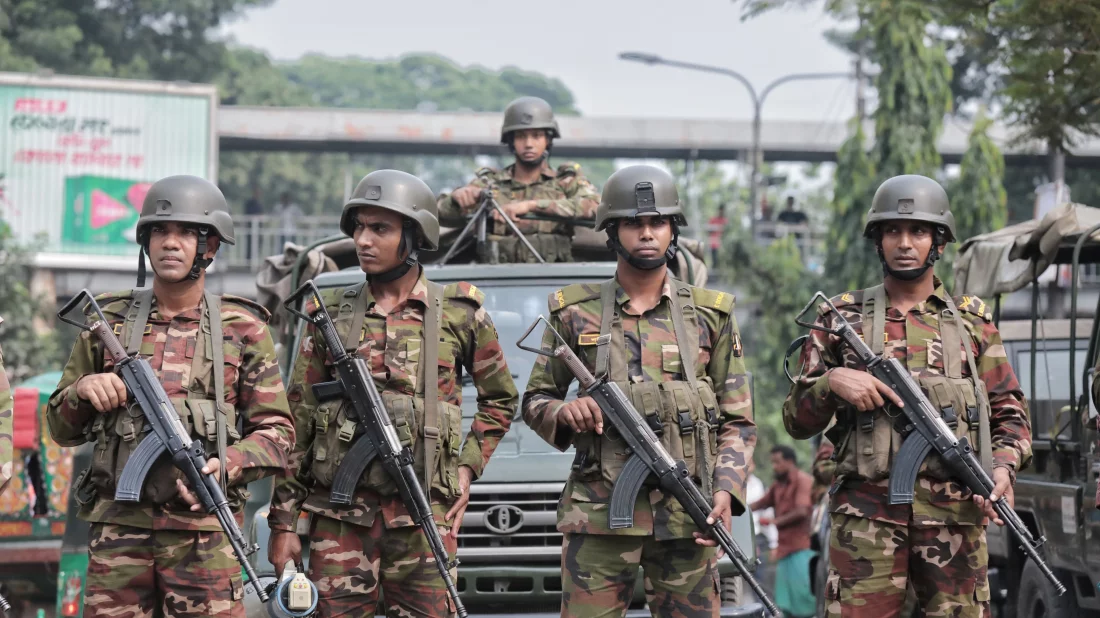
After more than a year and a half of nationwide deployment following the July 2024 mass uprising, the Bangladesh Army is now awaiting government instructions to withdraw its troops and return to barracks, following the 13th parliamentary election held on February 12.
The Army played a central role in maintaining law and order during a period marked by political upheaval and institutional disruption. Following the mass protests, initially sparked by the quota reform movement and culminating in the fall of Sheikh Hasina’s government on August 5, 2024, law enforcement agencies, particularly the police, were largely absent from the field.
In that vacuum, Army personnel were deployed across the country as a “striking force” beginning July 19, 2024.
An interim government assumed office on August 8, 2024, and troops continued operations nationwide under the provision of “Aid to Civil Power” to stabilize the situation.
Since then, the Army has remained actively engaged across all regions of the country.
However, following the February 12 parliamentary election, the scale of deployment has gradually decreased.
According to sources familiar with the development, the number of troops and operational camps has been significantly reduced.
At present, Army personnel are operating from approximately 50 camps across 63 districts, down from more than 200 camps established in the immediate aftermath of the uprising.
Over the past 18 months, the Army has conducted a wide range of operations, including counterterrorism drives, arrests of criminal suspects, recovery of illegal arms, dismantling of juvenile gangs, and maintaining security on highways.
Troops have also set up checkpoints in sensitive areas and assisted civil authorities during protests.
In addition to security operations, the armed forces supported market regulation efforts, countered cyber disinformation, and provided emergency relief during disasters.
Military sources said that since the uprising, forces have seized over 10,000 weapons and detained more than 22,000 suspected criminals, handing them over to civilian authorities.
The Army also received praise for its role in ensuring security during the 13th parliamentary elections and various university student union polls.
Their responsibilities included preventing ballot snatching, controlling unrest at polling centres, and maintaining a secure voting environment.
At the peak of election deployment, nearly 100,000 personnel from the Army, along with members of the Navy and Air Force, were mobilized across the country.
Following the polls, most troops were gradually withdrawn, leaving roughly one-third still deployed in the field.
During the post-uprising period, the interim government led by Professor Muhammad Yunus granted commissioned Army officers executive magistracy powers for an initial 60 days starting September 17, 2024.
These powers, covering 17 sections of the Criminal Procedure Code, were extended in phases.
In November 2025, the government extended the magistracy powers of the armed forces until February 28.
However, following the February election, this authority has not been renewed.
Army personnel are currently continuing their duties as a “striking force” in support of the civil administration.
When contacted, Inter-Services Public Relations (ISPR) Director Sami Ud Dowla Chowdhury told Dhaka Tribune that the Army is awaiting government instructions regarding withdrawal.
“When the government directs us, then troops will be withdrawn,” he said.
Earlier, on March 1, Home Minister Salahuddin Ahmed told journalists that armed forces personnel deployed in field-level security duties would be withdrawn soon.
He did not specify a timeline but said: “We will convene a high-level meeting soon to decide when they will be withdrawn from the field.”
Prior to the election, Army headquarters spokespersons had repeatedly indicated that the forces intended to return to barracks after the polls.
Chief of Army Staff General Waker-Uz-Zaman reiterated this position on February 15, during the CAS Darbar, stating that the Army would return to barracks once the newly elected government assumes office.
He added, however, that a portion of the force would remain deployed to assist in maintaining law and order until the police regain full operational capacity.
As the post-election transition continues, the timeline for the Army’s full withdrawal now hinges on government decisions, with security considerations and the readiness of civilian law enforcement likely to shape the final phase of this extended deployment.