







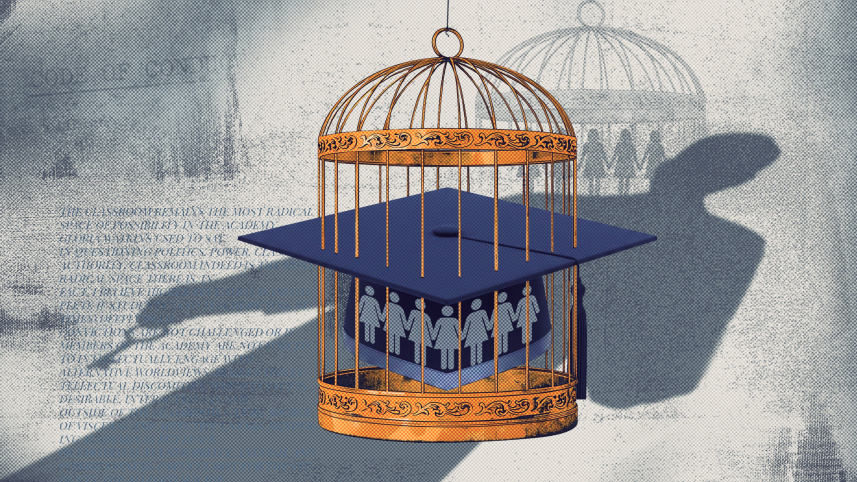
“The classroom remains the most radical space of possibility in the academy,” Gloria Watkins (more widely known as “bell hooks”) used to say. In discussions of politics, power, class, and authority, the classroom can indeed be such a space. In fact, higher education is incomplete if students’ and even teachers’ deeply held convictions are not challenged, or if members of the academy are not forced to intellectually engage with alternative worldviews. Besides this intellectual discomfort, interactions in and outside the classroom can be sources of visceral and affective unease, rendering academia a space of emotional vulnerability, anguish, and powerlessness, particularly for the students.The alleged suicide of Munira Mahzabin Mimo, a student of the Department of Theatre and Performance Studies at the University of Dhaka, brings to the fore critical questions on the latter. Sudip Chakraborty, an associate professor in the same department, has been arrested after a case of abetment of suicide was filed by Munira’s father. Following the arrest, the department has relieved Chakraborty of all academic duties, including teaching and participation in exam committees. The case remains pending.I do not wish to comment on the specifics of the case or on the culpability, if any, of the accused, who is also my senior colleague. Munira’s family and Chakraborty are both entitled to due process as well as a fair and impartial trial, leading to judgment based on evidence rather than prejudice or pressure. I would rather discuss a system that continues to fail, one that neither prevents harm with any predictability nor reliably redresses it, and that lacks an appropriate code of conduct governing interactions within and beyond the classroom.
Complaints of sexual harassment and abuse of power against faculty members and fellow students at universities are more common than we may assume because, as harsh as it may sound, we have grown apathetic to violence, so much so that anything other than deaths, or deaths by suicide, seems rather benign to us. This piece is not to be read as some claim of moral high ground, because I, too, am somewhat complicit as part of the system myself.At the University of Dhaka, complaints against teachers and fellow students are generally handled ad hoc at the department level and may also be referred to the central authority (the committee on sexual harassment, for instance) if needed. The “need” for referral by and large inhabits a grey area, and in many cases, students feel discouraged to take their claims further due to uncertainty and lack of clarity about the process and about what to expect. Notably, there is still no written policy categorically defining sexual harassment or laying down a process of redressal.
In this context, the university follows the guidelines formulated by the High Court Division in a writ petition filed in 2009 by the Bangladesh National Women Lawyers’ Association. Nonetheless, my experience as a student advisor shows how the lack of a clearly written policy, specifically tailored to the university, grossly fails survivors, adds to their quandary and agony, and in many cases, undermines due process, at times bringing in disproportionate punishment. More importantly, our university does not have a written code of conduct to guide relationships between university staff (including teachers) and students.
In most higher education institutions in the West, policies on sexual harassment are categorical, clearly defining the terms to identify and establish claims and elaborating the specific processes to pursue if and when such incidents occur. Similarly, there are written policies to guide and regulate relationships between members of the staff and students. Notably, since 2020, there has been a growing overlapping consensus among universities in the United Kingdom on banning or prohibiting intimate staff-student relationships. From around 2010-2015, leading universities in the US began categorically banning intimate relationships between students and staff.