







According to the World Bank’s April 2026 Bangladesh Development Update, the country’s poverty rate increased to 21.4 percent in 2025 from 18.7 percent in 2022, adding 14 lakh more poor people in 2025. At present, the government’s increasing number of digital welfare programmes—Family Card and Farmers’ Card—appear to be well-justified. But the question remains whether technology can meaningfully benefit those in the greatest need.
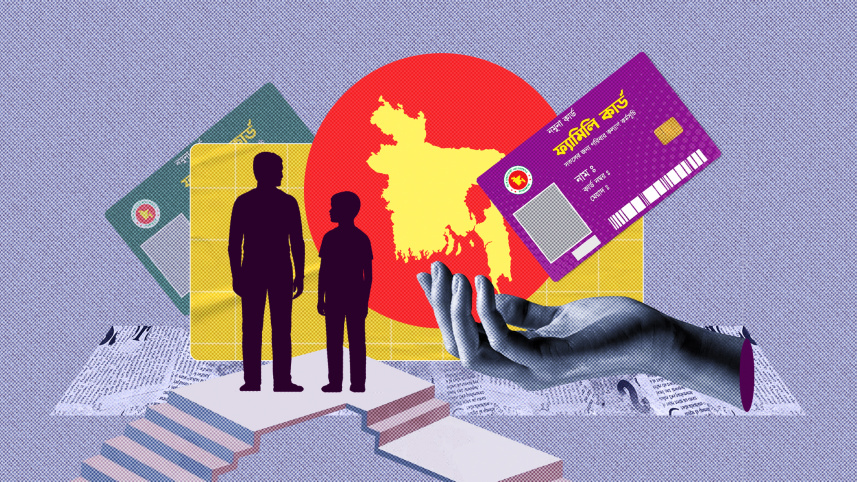
From an administrative perspective, the family card initiative is indeed a landmark project. It was launched on a trial basis last month in 14 upazilas, offering Tk 2,500 per month to over 40,000 women-headed households over four months. Simultaneously, the government is implementing 95 programmes under its social protection budget of Tk 1.26 lakh crore for the current fiscal year, accounting for 1.87 percent of the GDP.Nonetheless, a fundamental problem within the economy has yet to be addressed. According to the Bangladesh Bureau of Statistics (BBS), inflation has been higher than wage growth for 50 consecutive months till March 2026, despite a gradual rise in pay since February 2022. The BBS also reported a reduction in real wages by 1.9 percent in FY 2024. Given this state of the economy, improving food distribution via digital cards may not be of much use unless the actual volume of assistance keeps pace with rising market prices
A substantial portion of the 21.4 percent poverty rate comprises the new poor—once self-sufficient middle- and lower-middle-class families whose modest savings have been wiped out by successive shocks. The World Bank says that almost one-third of the population is still at risk of becoming poor because of a simple shock such as a natural calamity or illness.