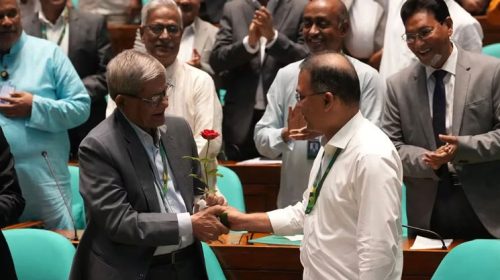


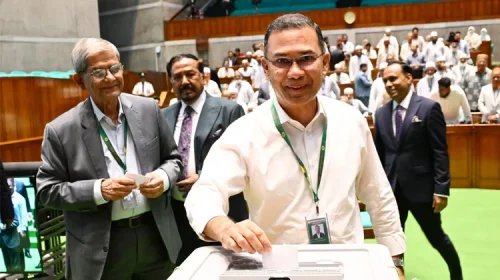


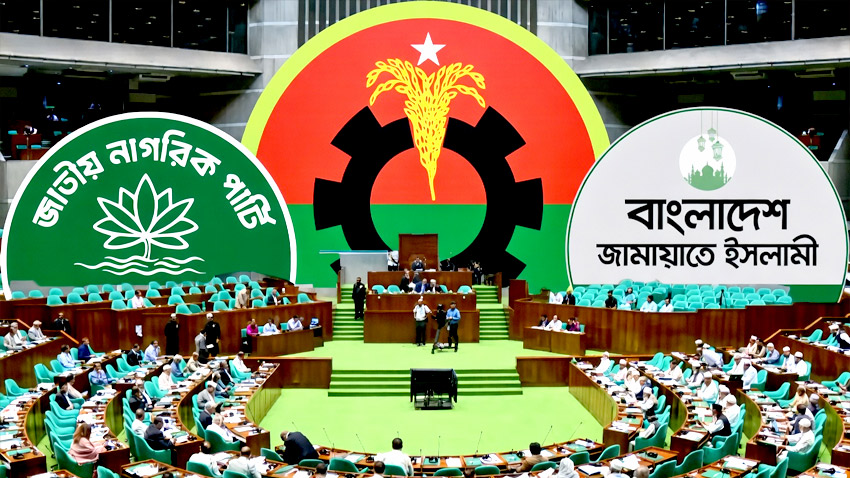
The national parliament completed an unprecedented legislative marathon on Friday, passing 91 bills over six consecutive days to settle 120 of the 133 ordinances issued during the interim government period, while 20 others lost their legal validity after lawmakers failed to ratify them before the constitutional deadline.The thirteenth parliament’s first session saw 87 bills passed to approve 113 ordinances, with some bills consolidating multiple ordinances.
Four separate repeal bills nullified seven additional ordinances including those establishing an independent Supreme Court Secretariat, a Supreme Court judge appointment framework, the National Parliament Secretariat provisions, and the National Human Rights Commission reform.
The remaining 13 ordinances were tabled but never voted upon, causing them to expire alongside the seven that were formally repealed.
Speaker Major (retd) Hafiz Uddin Ahmed Bir Bikram confirmed the session total of 91 bills, describing the legislative output as unprecedented in Bangladesh’s parliamentary history. The daily breakdown revealed an accelerating pace with two bills on April 5, seven on April 6, 14 on April 7, 13 on April 8, 31 on April 9, and 24 on the final day.
Among the 13 ordinances that expired without parliamentary approval are several consequential reforms including the Referendum Ordinance that provided the legal basis for the February 12 national vote, the Police Commission Ordinance, two ordinances on enforced disappearance prevention and remedy, the Anti-Corruption Commission Amendment Ordinance, the Microfinance Bank Ordinance, the Right to Information Amendment Ordinance, and ordinances covering customs, income tax, civil aviation, travel agency regulation, and two revenue policy and management frameworks.
The expiration of these ordinances raises significant legal questions about actions taken under their authority, particularly the February 2026 referendum conducted under the now-lapsed Referendum Ordinance. The legal status of activities carried out under these expired laws remains unclear, creating potential constitutional uncertainty.
The special committee formed to review the ordinances had recommended passing 98 unchanged and 15 with amendments while suggesting four be repealed and 16 be strengthened through fresh legislation.
However, the government departed from these recommendations in several instances. The National Human Rights Commission Ordinance, which the committee had recommended for future strengthening through new legislation, was instead repealed through a bill that reinstated the 2009 law governing the commission.
Conversely, the Police Commission Ordinance, recommended for passage with amendments, was never brought to a vote.
The July Mass Uprising Memorial Museum Bill proved the most contentious piece of legislation on the final day. Despite the special committee’s recommendation to pass it unchanged, ruling party MP Anisur Rahman introduced three amendments placing the Culture Minister as board chairperson, granting the government power to revoke any member’s nomination, and removing the fixed tenure provision for the chairperson.
Opposition Chief Whip Nahid Islam accused the ruling party of deception and breach of political agreement, while Law Minister Asaduzzaman acknowledged the departure from the understanding but attributed it to a private member’s amendment proposal. The confrontation culminated in the opposition walking out under Opposition Leader Shafiqur Rahman’s leadership.
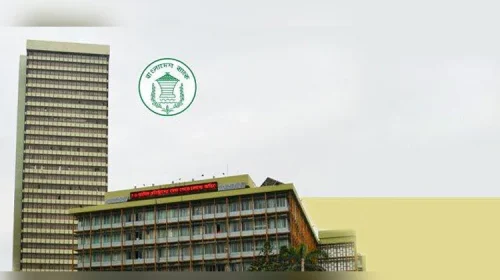
On the final day alone, 28 bills were passed covering development authorities for five cities, deposit protection, Bangladesh Bank amendments, Grameen Bank amendments, bank resolution, cyber security, national data management, Dhaka Central University, wildlife conservation, women and children protection, tobacco control, and welfare provisions for July uprising martyrs’ families.
The Speaker adjourned the session until April 15, bringing a brief pause to what has been the most legislatively intense opening session in the country’s parliamentary history.