







Abul Hashem has farmed the same three bighas of land in Pirgachha, Rangpur for over four decades. He remembers a time when his father’s fields were a mosaic of colour: the amber of “kaon” (foxtail millet), the deep earthy tones of indigenous lentils, and the vibrant greens of half a dozen heirloom gourds.
Today, every inch of Hashem’s land is a monochrome of emerald and gold. For thirty years, he has grown the same two varieties of high-yielding paddy. He cannot recall the last time he saw kaon growing nearby.
Hashem is not alone. Across Bangladesh, millions of farmers have made the same rational, individually sensible choice – one that is collectively damaging. And the countryside has been transformed accordingly.
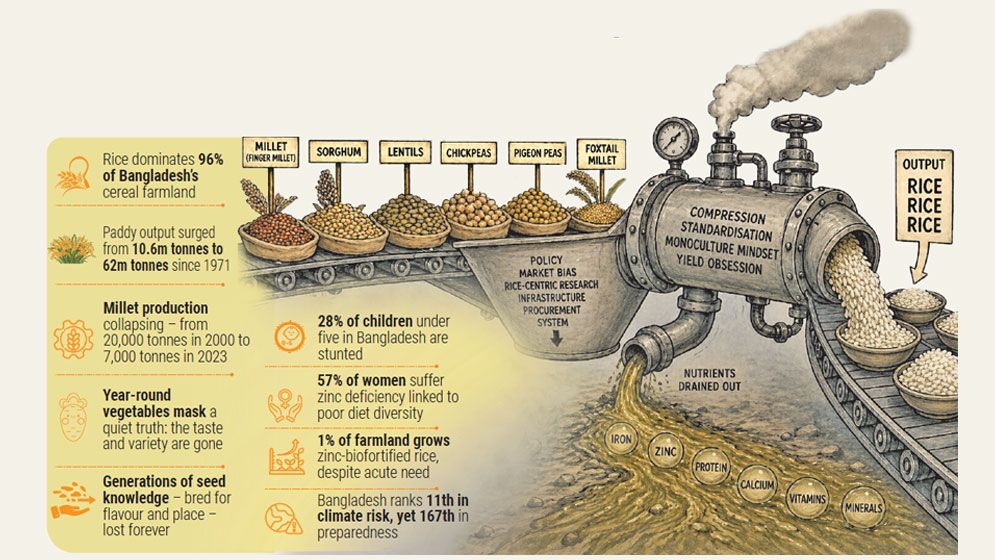
According to data from the Bangladesh Bureau of Statistics (BBS), rice now blankets around 75% to 78% of the total cropped area and more than 96% of the country’s cereal farmland.
This overwhelming dominance has pushed nearly every other grain to the margins of cultivation and, increasingly, to the margins of memory.

DhakaSunday , 26 April 2026