





Professor Ali Riaz, special assistant to the chief adviser, on Tuesday said that although the July Charter appears in simple black-and-white print, every line of it reflects the sacrifices and suffering of the people of Bangladesh.
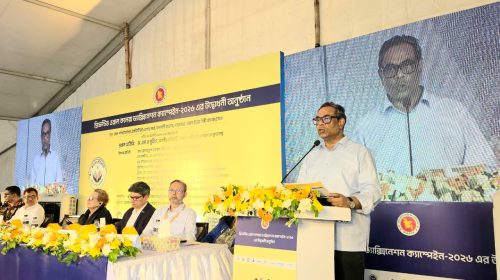
He made the remarks while addressing an interactive programme on public awareness regarding the referendum, held at the Nabab Nawab Ali Chowdhury Senate Building auditorium of Dhaka University.
Paying tribute to those killed and injured during the July movement, Ali Riaz said their struggle was not driven by a desire for power but by a vision of dignity and justice. “They did not aspire to become prime minister or president. They wanted a state that ensures respect, rights and fairness. The July Charter is an acknowledgement of that debt,” he said.
He questioned whether the nation could ignore the sacrifices that made democratic discourse possible, adding that the charter represents a collective commitment to honouring those who gave their lives. “When I read the July Charter, I hear the voices of grieving mothers who lost their children,” he said.Ali Riaz said the charter was drafted through extensive consultations with political parties, civil society groups, professional bodies, and individuals, ensuring that it reflects a broad national consensus.Explaining the political background behind the removal of the caretaker government system, he said its abolition paved the way for one-person dominance and flawed elections. He alleged that the last three general elections were orchestrated by a single authority, made possible through structural manipulation of the electoral system.
Referring to the 2014 election, he claimed that the appointment of the chief election commissioner bypassed the formal selection process, resulting in a compromised electoral outcome. “No one committed to democracy can accept the continuation of such practices,” he said.
He noted that political parties have now agreed under the July National Charter to introduce a consultative mechanism for forming future Election Commissions, involving representatives from the ruling party, the main opposition, and the second-largest opposition party in parliament.
Ali Riaz also highlighted proposed reforms to key institutions, including the Public Service Commission, and said the president’s unilateral power to grant pardons would be curtailed if the charter is implemented.
He said emergency powers would also be redefined, removing vague provisions such as “internal disturbance” and requiring cabinet approval that includes opposition participation.
Discussing constitutional reforms, Ali Riaz said future amendments would require a two-thirds parliamentary majority and endorsement by at least 51 members of a proposed 100-seat upper house, preventing unilateral changes driven by individual interests.
He also spoke about reforms to the presidential election process and Article 70, which restricts lawmakers’ voting freedom. “Forcing MPs into absolute party obedience has reduced parliament to a rubber-stamp body rather than a forum for debate,” he said.
Under the charter, he said, opposition lawmakers would chair four key parliamentary standing committees, strengthening accountability and checks on executive power.
Calling on citizens to support the July Charter, Ali Riaz said its full implementation is essential to prevent the return of authoritarian practices and to establish a democratic, inclusive, and accountable governance system.
The event was attended by Chief Adviser’s Special Assistant Monir Haidar, University Grants Commission Chairman Dr SMA Fayez, Dhaka University Pro-Vice-Chancellor Prof Dr Sayma Haque Bidisha, July movement victims, and vice-chancellors, teachers, students, and officials from various universities.