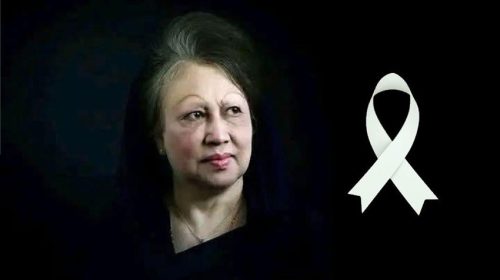




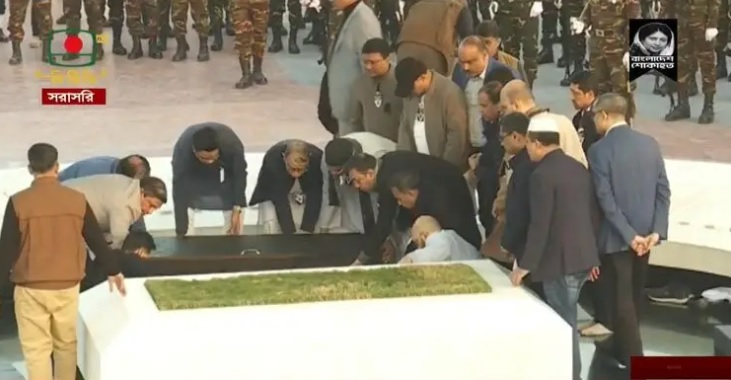
Former prime minister and BNP Chairperson Begum Khaleda Zia was laid to rest on Wednesday afternoon beside the grave of her late husband, former president Ziaur Rahman, at Zia Udyan in the capital’s parliament area.
Her burial was completed around 4:30pm with full state honours. Her elder son and BNP Acting Chairman Tarique Rahman attended the burial ceremony.
Earlier in the day, funeral prayers were held at the South Plaza of the Jatiya Sangsad Bhaban and at Manik Mia Avenue. The janaza was attended by Chief Adviser Prof Muhammad Yunus, Army Chief General Waker-Uz-Zaman, senior leaders of the BNP and other political parties, as well as tens of thousands of mourners.
Before the prayers, Tarique Rahman sought prayers for his mother and asked forgiveness on her behalf.
Khaleda Zia, who had been suffering from multiple serious health complications for several years, passed away at Evercare Hospital in Dhaka at 6:00am on Tuesday. She was 80.
The three-time prime minister had long battled a range of ailments, including arthritis, diabetes, kidney, liver, lung and heart diseases, as well as eye-related complications. She returned to Bangladesh on January 7 this year after receiving treatment in London but was hospitalised again on November 23 following a deterioration in her condition. She remained under treatment for nearly one and a half months before her death.
Khaleda Zia led the Bangladesh Nationalist Party (BNP) for 43 years. She joined the party in 1982 and was elected chairperson unopposed through the party council in 1984, a position she held until her death. During her political career, she was elected prime minister three times and made history as the country’s first female prime minister.
She earned the title “Uncompromising Leader” for her role in the movement against military ruler HM Ershad.
Khaleda Zia entered politics following the assassination of her husband, President Ziaur Rahman, on May 30, 1981—a period that plunged the BNP into crisis. Rising from a private life as a homemaker, she assumed the party’s leadership at a critical moment and went on to become one of Bangladesh’s most influential political figures.
Throughout her four-decade-long political career, she was known for avoiding personal attacks against her opponents. In an interview, she once said: “I never engage in personal attacks.”