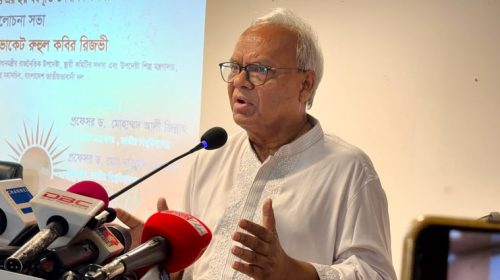





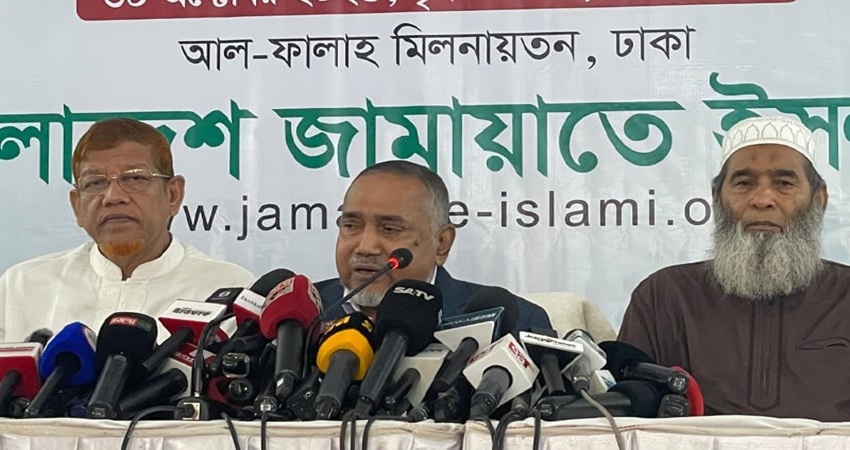
Dr. Syed Abdullah Muhammad Taher, Naib-e-Ameer of Jamaat-e-Islami, has called for a referendum prior to the national election, emphasizing that it should be held to approve the proposed reforms before the February polls. He made the remarks at an urgent press conference held on Thursday (October 30) at the fourth floor of Al-Falah Auditorium in Mogbazar, Dhaka.
Taher said that certain settled issues are being used by some groups and political parties to create confusion and tension in the political environment. “Partial statements posted on Facebook and fabricated claims are creating doubts about whether Jamaat-e-Islami will participate in the February elections,” he said.
He clearly stated Jamaat’s position: “We want the full implementation of the July Charter through legal means. An immediate order should be issued based on the commission’s recommendations. We demand a referendum before the national elections, and the elections in February should be held based on the results of that referendum. Our message is clear and unambiguous.”
Addressing Dr. Yunus, he added, “It would be ideal if the order is issued today. There are precedents of issuing orders at midnight. If not today, it must be issued tomorrow without any delay. Any postponement will affect the national election, and those responsible will be accountable to the nation.”
Taher noted that when the current government assumed office, one of its three clear commitments was to carry out reforms. According to him, this is the interim government’s only achievement. “If properly implemented, these reforms can bring significant political and administrative changes, creating what we call a ‘New Bangladesh.’”
He explained that discussions with the National Unity Commission concluded with a summary of active participation by 31 political parties, resulting in consensus on many points. Taher rejected claims that the commission was implementing a single party’s agenda, saying that all discussions were based solely on the commission’s proposals.
Taher added, “Some parties initially disagreed on various points, but through discussion, consensus was reached. Except for NCP, all parties signed the agreement, including BNP and Jamaat jointly signing the charter. Of the 60–65 proposed reforms, full consensus was achieved on many, and for others, 75–90% agreement was reached. This is how decisions are made worldwide—majority rule.”
He further clarified, “A minority ‘note of dissent’ does not invalidate a decision, similar to a High Court ruling where one dissenting judge does not change the verdict. Yet some parties claim that such notes of dissent must be submitted for a referendum. If followed literally, it would require a referendum every day for every point. Such claims create confusion and prevent the public from understanding the real issue.”
Taher emphasized that referendum and national elections are two separate subjects. “The referendum validates the reforms under the charter, while the national election is about selecting representatives, forming the government, and state formation. Combining the two will jeopardize the transparency of the election. We want a free, fair, and transparent national election without any confusion or doubt.”
He appealed to those attempting to create a disruptive environment to refrain from doing so, warning that any delay or manipulation could harm the upcoming election.
JI leaders present at the press conference included Naib-e-Ameer Professor Mujibur Rahman, Assistant Secretary General Maulana ATM Mashum, Dr. H.M. Hamidur Rahman Azad, and Central Media Secretary Matiur Rahman Akand.